
Need for Crown After Root Canal Treatment in Panchkula
Published Date: December 09, 2025 Last Update: December 09, 2025
Author: Dr. Manpreet S. Walia
So you've just had a root canal treatment in Panchkula, or perhaps your dentist has recommended one. The tooth pain is finally manageable, you're feeling relieved, and then your dentist mentions something that catches you off guard: "You'll need a crown on that tooth."
Your first thought might be, "Wait, I just spent money on the root canal. Now you're telling me I need to spend more on a crown? Is this really necessary, or is my dentist just trying to upsell me?"
It's a fair question, and one that many patients ask. Let us break down exactly why experienced root canal specialists in Panchkula almost always recommend getting a crown after RCT, and why skipping this step could end up costing you much more in the long run.
Understanding What Happens During Root Canal Treatment
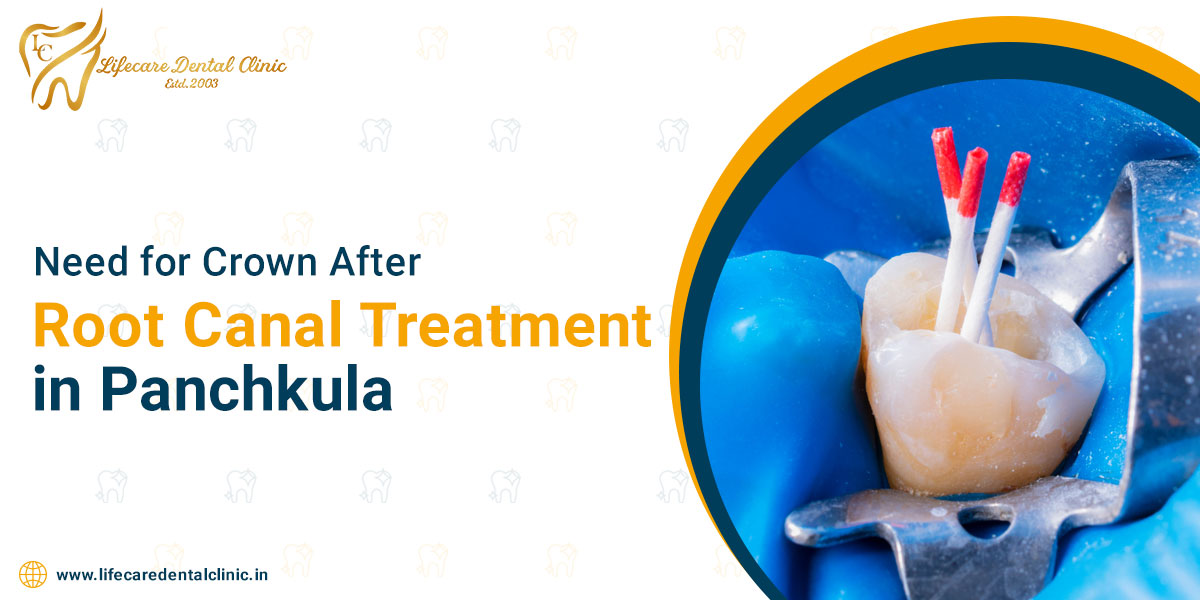
Before we talk about crowns, let's quickly understand what happens to your tooth during root canal treatment. The procedure involves removing the infected or damaged pulp from inside your tooth, cleaning out the root canals, and then sealing them to prevent future infection.
While this saves your tooth from extraction, the process also involves removing a significant amount of tooth structure. Your dentist needs to create an access opening, remove all the infected tissue, and shape the canals properly. By the time the root canal is complete, your tooth has lost considerable internal structure.
Think of it like a building—the root canal removes the interior walls while keeping the outer shell standing. The structure is still there, but it's much weaker than it was before.
Why Your Tooth Becomes Fragile After RCT?

Here's the part many people don't realize: a tooth that's undergone root canal treatment is no longer "alive" in the traditional sense. The blood supply and nerve have been removed, which means the tooth no longer receives nutrients from within.
Over time, this causes the tooth to become more brittle. It's like the difference between a fresh green branch and a dry, dead twig. The dry twig snaps easily under pressure, right? That's essentially what can happen to your tooth after RCT.
Add to this the fact that a portion of your tooth structure has been removed during the procedure, and you've got a tooth that's significantly more vulnerable to fractures. Every time you chew, you're putting pressure on this weakened tooth. Without protection, it's only a matter of time before something goes wrong.
What Happens If You Skip the Crown?
Here's what typically happens:
1. The tooth fractures
This is the most common outcome. You're eating your favorite meal, maybe some tandoori chicken or crispy parathas—and suddenly you feel a crack. The tooth has split vertically, often right down to the root.
2. The fracture goes below the gum line
This is the nightmare scenario. When a tooth fractures vertically below the gum line, it usually cannot be saved. You've now lost the tooth entirely, despite having invested in the root canal treatment.
3. You end up needing an extraction and implant
Once the tooth is fractured beyond repair, your only option is extraction. And if you want to replace that tooth properly, you're looking at a dental implant, which costs significantly more than a crown would have.
How a Crown Protects Your Investment?
A dental crown is essentially a protective cap that covers your entire tooth above the gum line. It's custom-made to fit your tooth perfectly and is designed to withstand the forces of chewing and biting.
When you get a crown after root canal treatment, you're accomplishing several things:
1. Structural reinforcement
The crown holds the remaining tooth structure together, preventing cracks and fractures. It's like putting a helmet on something fragile—it distributes the forces evenly and protects what's inside.
2. Restoration of function
A properly fitted crown allows you to use that tooth normally again. You can chew on it, bite with it, and trust that it won't break during your meals.
3. Aesthetic improvement
Modern crowns are made to match your natural teeth perfectly. In fact, most people won't even be able to tell which tooth has a crown. You get your smile back along with your functionality.
4. Long-term cost savings
Yes, the crown is an additional expense upfront. But compare that to the cost of losing the tooth, getting an extraction, and then needing an implant or bridge. The crown is actually the economical choice when you look at the bigger picture.
When Can You Skip the Crown?
Now, I mentioned that root canal specialists in Panchkula "almost always" recommend crowns. Are there exceptions?
In some cases—typically with front teeth that haven't had extensive decay or haven't lost much structure—your dentist might say a crown isn't immediately necessary. Front teeth don't bear as much chewing force as back teeth, so they're sometimes okay with just a filling.
However, even in these cases, many dentists still recommend crowns for the added protection and longevity. It really depends on the specific situation, and your dentist is the best person to assess whether your particular tooth can do without one.
Final Thoughts
The need for a crown after root canal treatment isn't about dentists in Panchkula trying to make extra money; it's about protecting your tooth and ensuring that the time and money you've already invested in saving it doesn't go to waste.
A root canal without a crown is like building a house without a roof. Sure, the structure is there, but it's vulnerable to damage and won't last as long as it should. Don't let your treated tooth become a statistic. Listen to what experienced root canal specialists in Panchkula recommend, and give your tooth the protection it deserves. To book your appointment click here.
Leave A Reply