
Can Clear Aligners Fix Crowded Teeth? What an Orthodontist Checks Before Treatment
Published Date: September 22, 2026 Last Update: September 22, 2026
Author: Dr. Manpreet S. Walia
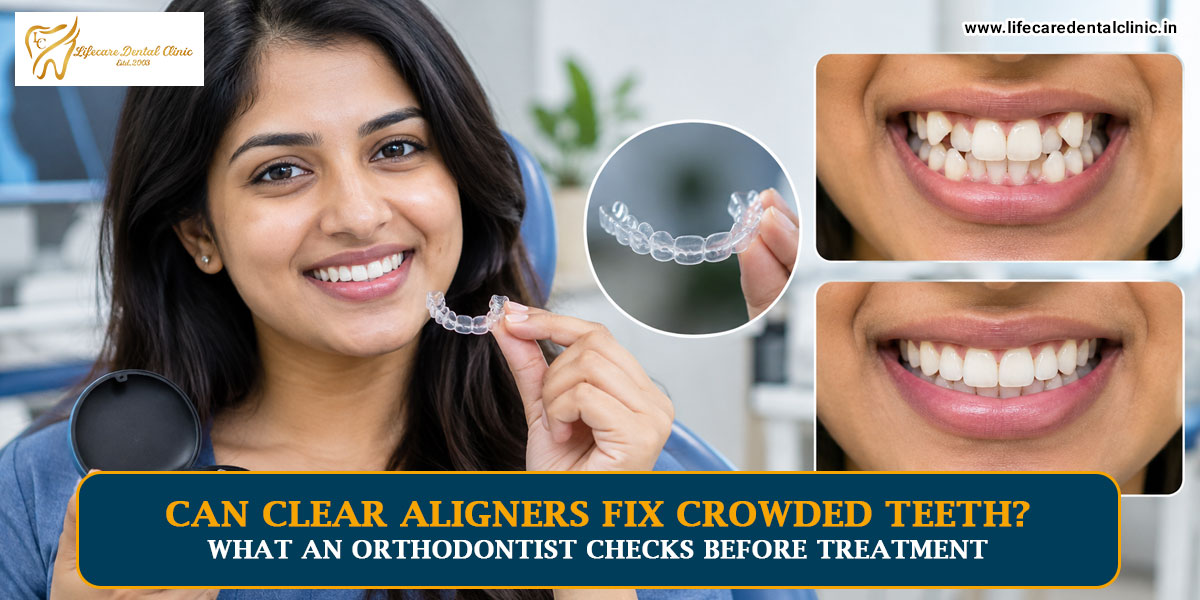
Crowded teeth are one of the most common reasons people consider orthodontic treatment. When teeth overlap, twist, or don't have enough room to sit properly in the dental arch, brushing and flossing can also become more difficult.
Clear aligners offer a discreet way to correct many types of crowding. However, not every crowded smile can be treated with invisible aligners in exactly the same way. If you're considering Orthodontics Treatment in Chandigarh or searching for Clear Aligner Braces in Chandigarh, the first step should be an orthodontic assessment rather than simply ordering aligners.
What Does "Crowded Teeth" Actually Mean?
Dental crowding occurs when there isn't enough space in the dental arch for the teeth to align properly. You may notice:
- Teeth overlapping each other
- Rotated teeth
- One tooth positioned behind another
- Teeth that appear pushed forward or backward
- Difficulty flossing between certain teeth
- Food frequently getting trapped between crowded teeth
Crowding can range from mild to severe, and its cause can differ from one person to another. That's why two people with similar looking crooked teeth may require completely different treatment plans.
Can Invisible Aligners Fix Crowded Teeth?
In many suitable cases, yes. Invisible aligners use a series of custom-made trays to apply controlled forces to specific teeth. Each stage of treatment is planned to move the teeth gradually toward their intended positions. For mild to moderate crowding, clear aligners can often provide an effective and discreet orthodontic option.
More complex cases require a detailed assessment. Depending on the severity of crowding, tooth position, bite, gum health, and available space, traditional braces or another orthodontic approach may be more appropriate.
The important question isn't simply, "Can aligners straighten my teeth?"
It is:
"Can aligners achieve the specific tooth movements my case requires?"
What Does an Orthodontist Check Before Recommending Aligners?
An orthodontist doesn't assess crowding by looking at the front teeth alone. Several factors need to be considered.
1. Available Space
Your orthodontist determines how much space is available in the dental arch and how much is required to align the teeth.
2. Tooth Position
Rotated, tilted, or severely displaced teeth may require specific movements that influence whether clear aligners are suitable.
3. Your Bite
Crowding may exist alongside an overbite, underbite, crossbite, or other bite problem.
Correcting the visible crowding without addressing the bite may not produce the desired functional result.
4. Gum and Bone Health
Orthodontic tooth movement requires healthy supporting tissues.
If you have active gum disease, bleeding gums, significant recession, or other periodontal concerns, these issues should be assessed and treated before or alongside orthodontic treatment as appropriate.
5. Root Position
The visible part of a tooth doesn't tell the complete story. The roots and supporting bone also matter when planning orthodontic movement. Depending on the case, dental X-rays or other diagnostic records may be required.
Why Some Crowded Teeth Need More Than Just "Straightening"?

A common mistake is to think of orthodontic treatment as simply moving teeth until they look straight. Your teeth also need to function together. A comprehensive orthodontic plan considers:
- Alignment: Are the teeth positioned correctly?
- Bite: Do the upper and lower teeth meet appropriately?
- Function: Can you chew comfortably?
- Cleanability: Can you maintain good oral hygiene around the teeth?
- Stability: Can the result be maintained after treatment?
This is why professional orthodontic planning is more important than choosing aligners based solely on their appearance.
Do Clear Aligners Require Tooth Removal?
Not necessarily. The need for extraction depends on the severity of crowding, facial and dental proportions, tooth position, bite, and the amount of space that needs to be created. In some cases, an orthodontist can create space through techniques such as controlled expansion or interproximal reduction, where a small amount of enamel is carefully reshaped between selected teeth. In other cases, extraction may be recommended. The decision should be made after a complete orthodontic assessment rather than based on a general rule.
What Is Interproximal Reduction?
You may hear your orthodontist refer to IPR, or interproximal reduction. This involves carefully removing a very small amount of enamel between selected teeth to create additional space. It is not appropriate for every patient, and the amount of enamel that can safely be removed is limited. When indicated, IPR can be incorporated into an orthodontic treatment plan to help create the space needed for tooth alignment. Your orthodontist should explain exactly where and why it is being recommended.
How Long Does It Take to Correct Crowded Teeth With Aligners?
There isn't one standard treatment time. Treatment duration depends on:
- Severity of crowding
- Number of teeth requiring movement
- Type of bite problem
- Amount of movement required
- Patient compliance
- Biological response to treatment
- Whether additional orthodontic procedures are required
A patient with minor crowding may complete treatment considerably sooner than someone with significant crowding and a complex bite. Your orthodontist can provide an estimated timeline after examining your teeth and developing a treatment plan.
Why Wearing Aligners Consistently Matters?

Clear aligners are removable, which makes them convenient for eating, brushing, and special occasions. But that flexibility also means treatment depends heavily on patient compliance. If you don't wear your aligners according to your orthodontist's instructions, the teeth may not move according to the planned sequence. This can result in:
- Delayed treatment
- Poor aligner fit
- Additional refinement aligners
- Changes to the treatment plan
Clear aligners work best when patients understand that convenience comes with responsibility.
What Happens After Crowded Teeth Are Straightened?
Finishing your final aligner doesn't mean orthodontic treatment is completely over. Teeth can naturally move after active orthodontic treatment. A retainer helps maintain their new positions. This is why retention should be considered part of the original treatment plan rather than an optional extra. An Invisalign retainer or another appropriate retainer may be recommended depending on your case and treatment system. The orthodontist will explain how frequently you need to wear it and for how long.
Remember:
Aligners move teeth. Retainers help maintain the result.
Clear Aligners or Braces for Crowded Teeth?
Both can be effective orthodontic treatments. Clear aligners offer advantages such as:
- Discreet appearance
- Removability
- Easier access for brushing and flossing
- No brackets or wires
- Digital treatment planning
Traditional braces offer:
- Continuous force because they remain attached to the teeth
- Predictable control for many types of tooth movement
- Suitability for a broad range of orthodontic cases
Neither option should be selected simply because it looks more attractive.
The treatment should be chosen based on the movements your teeth require.
When Should You See an Orthodontist for Crowded Teeth?
You don't need to wait until crowding becomes severe.
An orthodontic consultation can be useful if you notice:
- Increasing overlap between teeth
- Difficulty cleaning certain areas
- Teeth becoming more rotated
- Changes in your bite
- Difficulty chewing
- Persistent food trapping
- Concerns about the appearance of your smile
Early assessment can help identify the cause and determine whether treatment is necessary.
Clear Aligner Treatment at Lifecare Dental Clinic
At Lifecare Dental Clinic, orthodontic treatment begins with an assessment of your individual dental condition.
If you're considering Clear Aligner Braces in Chandigarh, the focus is on determining whether invisible aligners can achieve the movements your teeth require.
Your teeth, bite, gums, available space, and treatment goals are considered before recommending an orthodontic approach.
If clear aligners are suitable, treatment can then be planned around the required tooth movements and monitored throughout the process.
The retention stage is also an important part of the plan, helping protect the alignment achieved during active treatment.
Don't Choose Aligners Before Understanding Your Teeth
Crowded teeth can look like a straightforward cosmetic concern, but orthodontic treatment involves much more than making teeth appear straight.
The position of the roots, supporting bone, bite, available space, gum health, and long term stability all matter.
If you're considering Orthodontics Treatment in Chandigarh, speak with an orthodontist before choosing an aligner system.
A proper assessment can tell you whether invisible aligners are appropriate for your case, what treatment will involve, and what you can realistically expect from the result.
At Lifecare Dental Clinic, the goal is to create an orthodontic plan based on your teeth and your needs, not simply fit you into a standard aligner package.
Leave A Reply