
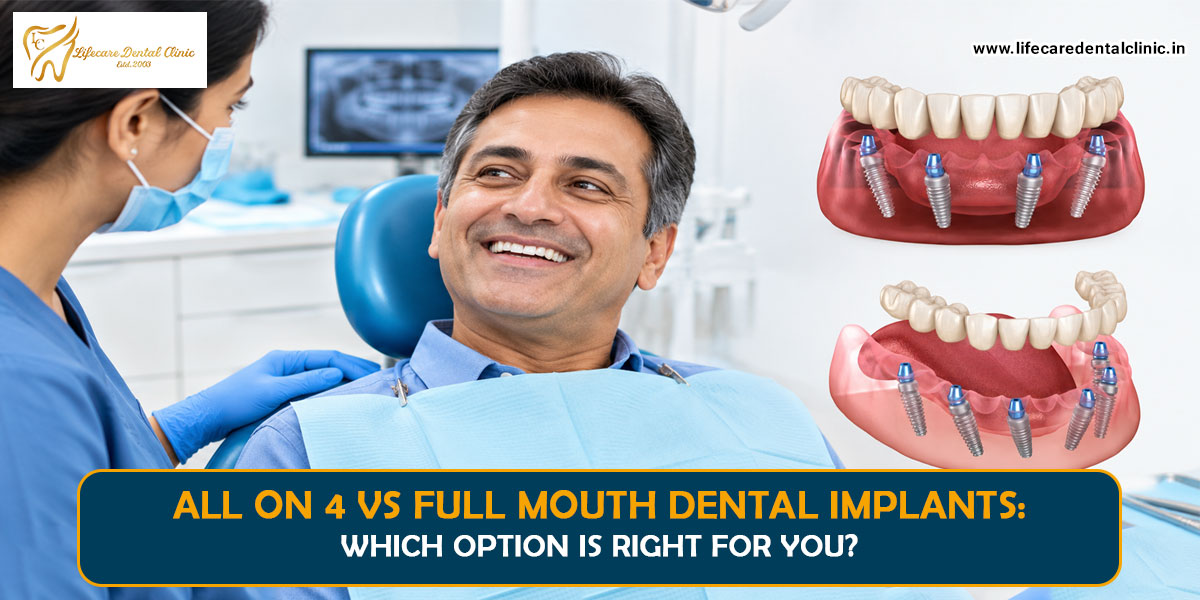
All on 4 vs Full Mouth Dental Implants: Which Option Is Right for You?
Published Date: September 18, 2026 Last Update: September 18, 2026
Author: Dr. Manpreet S. Walia
Losing several teeth can affect much more than the appearance of your smile. Chewing may become difficult, certain foods may become harder to eat, and changes in the remaining teeth can affect your bite over time. For patients who have lost most or all of their teeth, implant supported treatment can provide a stable alternative to conventional removable dentures. Two terms patients frequently encounter are All on 4 dental implants and full mouth dental implants.
Although they are sometimes used interchangeably in casual conversations, they describe different approaches to replacing an entire arch of teeth. If you're researching dental implants in Chandigarh or comparing treatment options at the best dental clinic in Chandigarh, understanding this distinction can help you have a more informed conversation with your dentist.
What Are Full Mouth Dental Implants?
"Full mouth dental implants" is a broad term used for implant supported rehabilitation when most or all teeth need to be replaced. It doesn't necessarily mean that one implant is placed for every missing tooth.
Depending on your anatomy, bone availability, bite, remaining teeth, and restorative requirements, a full arch restoration can be supported by a strategically planned number of implants. The final restoration may replace an entire upper arch, lower arch, or both.
The treatment is designed around the patient's individual anatomy rather than following one fixed implant count.
What Is All on 4 Dental Implant Treatment?
All on 4 dental implants is a specific full-arch treatment concept that uses four strategically positioned implants to support a fixed full-arch prosthesis in appropriate cases.
The concept takes advantage of available bone in areas of the jaw where implant placement is feasible. Angled placement of the posterior implants can sometimes help avoid anatomical structures and make use of available bone.
However, the treatment isn't automatically suitable for everyone. A detailed examination is required to determine whether four implants can provide adequate support for the proposed restoration.
All on 4 vs Full Mouth Dental Implants
The biggest difference is that All on 4 is a specific implant treatment approach, while full mouth dental implants describe a broader category of comprehensive tooth replacement.
| Consideration | All on 4 | Full Mouth Dental Implants |
|---|---|---|
| Implant concept | Uses four strategically positioned implants per arch in suitable cases | May use a different number of implants depending on the treatment plan |
| Restoration | Full arch prosthesis | Full arch or comprehensive implant supported restoration |
| Implant number | Four per arch in the classic concept | Determined according to anatomy and restorative requirements |
| Bone requirements | Designed to make use of available bone in appropriate cases | Depends on implant positions and individual treatment plan |
| Suitable for | Selected patients requiring full arch replacement | Patients requiring extensive or complete tooth replacement |
| Planning | Requires detailed implant and prosthetic planning | Requires detailed implant and prosthetic planning |
The appropriate choice should be determined after examining your teeth, gums, jawbone, bite, and overall oral health.
Does Everyone Need Four Implants?
No. This is one of the most important things to understand before choosing an implant treatment. A treatment advertised as "four implants for everyone" doesn't account for the differences between patients. Factors that can influence implant planning include:
- Jawbone volume and quality
- Location of nerves and sinuses
- Gum health
- Existing teeth
- Bite relationship
- Jaw shape
- Available restorative space
- Aesthetic requirements
- Medical history
- Long term maintenance considerations
A CBCT scan may be recommended when three dimensional information is required for treatment planning.
Your dentist can use the imaging, clinical examination, and restorative assessment to determine how many implants are appropriate and where they should be positioned.
What If You Have Severe Bone Loss?
Bone loss is common in patients who have been missing teeth for a long time. When a natural tooth is lost, the bone that previously supported its root can gradually resorb. This can affect the amount of bone available for conventional implant placement. That doesn't automatically rule out implant treatment. Depending on the individual case, treatment planning may involve:
- Using areas with adequate existing bone
- Bone grafting
- Sinus augmentation where appropriate
- Alternative implant positioning
- A different implant supported restoration
The important point is that bone availability should be evaluated rather than assumed.
Why Gum Health Matters Before Full Mouth Implant Treatment?
Implants are supported by bone, but the health of the surrounding gum tissues is also important. If you have active periodontal disease, it should be addressed before proceeding with elective implant treatment. Warning signs include:
- Bleeding gums
- Persistent bad breath
- Gum recession
- Loose teeth
- Swollen gums
- Pus around the gums
- Significant bone loss
Patients with a history of gum disease may require periodontal assessment and treatment before implant placement. Long term implant maintenance also requires good oral hygiene and professional monitoring.
What Does Full Arch Implant Treatment Involve?
Although every case is different, comprehensive implant treatment usually involves several stages.
1. Detailed Examination
Your dentist evaluates your remaining teeth, gums, bite, jawbone, and overall oral health.
2. Diagnostic Imaging
Digital X-rays and CBCT imaging may be used when additional information is required for implant planning.
3. Treatment Planning
The implant positions and final restoration are planned together.
This is important because implants aren't simply placed where there happens to be bone. Their positions need to support the final teeth and allow appropriate cleaning and function.
4. Implant Placement
The implants are placed according to the planned surgical approach.
5. Healing and Integration
The implants require time to integrate with the surrounding bone.
In selected cases, a temporary restoration can be provided according to the treatment plan.
6. Final Restoration
Once healing and implant stability have been appropriately assessed, the definitive full arch restoration is fabricated and fitted.
Can You Get Fixed Teeth on the Same Day?
You may have heard advertisements for "teeth in one day" or "same day implants." Immediate loading is possible in selected cases, but it isn't appropriate for every patient. Immediate or early loading depends on factors such as:
- Primary implant stability
- Bone quality
- Number and position of implants
- Bite forces
- Overall oral health
- The type of restoration being used
Your dentist should determine whether immediate loading is clinically appropriate rather than promising the same timeline to every patient.
Are Full Mouth Dental Implants Better Than Dentures?

There isn't one solution that is automatically better for every patient. Traditional dentures are removable and can provide a non-surgical method of replacing missing teeth. Implant supported restorations use implants to provide support and retention, which can offer greater stability for appropriate patients.
However, implant treatment involves surgery, healing, maintenance, and a higher initial investment than conventional removable dentures. The right choice depends on your oral health, anatomy, expectations, budget, and willingness to undergo implant treatment. A thorough consultation should explain both the advantages and limitations of the available options.
How Long Can Full Mouth Dental Implants Last?
Implants are designed for long term use, but no implant treatment should be described as maintenance free or guaranteed for life. Long term outcomes depend on factors such as:
- Oral hygiene
- Gum health
- Smoking or tobacco use
- Bite forces
- Overall health
- Quality of treatment planning
- Regular professional maintenance
The prosthetic teeth can also experience wear or damage over time and may require repair or replacement even when the underlying implants remain stable. Regular dental examinations are therefore an important part of maintaining implant supported teeth.
What Does Dental Implant Treatment Cost in Chandigarh?
The cost of dental implants in Chandigarh varies considerably between patients. There isn't a meaningful single price for "full mouth implants" because the treatment may involve very different clinical situations. The overall cost can depend on:
- Number of implants
- Implant system
- Type of final restoration
- Diagnostic imaging
- Bone grafting or other additional procedures
- Condition of the remaining teeth
- Laboratory requirements
- Temporary restoration
- Follow up and maintenance
When comparing treatment costs, ask for a complete treatment plan rather than comparing the price of an implant fixture alone. A lower quoted price may not include the crown, abutment, imaging, temporary teeth, additional procedures, or other components.
Questions to Ask Before Choosing a Dental Implant Clinic
If you're looking for the best dental clinic in Chandigarh for full arch implant treatment, don't hesitate to ask detailed questions.
1. How many implants do I actually need?
The answer should be based on your anatomy and proposed restoration.
2. Do I have enough bone?
Ask whether your existing bone is sufficient or whether additional treatment is required.
3. Are my gums healthy enough for implants?
Active gum disease should be treated before implant placement.
4. What type of restoration will I receive?
Understand whether the final teeth will be fixed or removable and what materials are being used.
5. What is included in the treatment cost?
Ask for a complete breakdown.
6. How long will treatment take?
Your timeline depends on healing, additional procedures, implant stability, and the type of restoration.
7. What maintenance will I need?
Implant supported teeth require regular cleaning and professional monitoring.
Why Choose Lifecare Dental Clinic for Dental Implants in Chandigarh?
At Lifecare Dental Clinic, implant treatment is approached as a complete restorative process rather than simply an implant placement procedure. Before recommending All on 4 dental implants or another form of full mouth dental implants, the patient's oral health, gums, bone, bite, remaining teeth, and restorative requirements need to be assessed.
This helps create a treatment plan based on the patient's actual clinical situation. Whether you're missing one tooth, several teeth, or an entire arch, the appropriate treatment depends on your individual needs. The objective is to restore chewing function, provide a stable replacement for missing teeth, and create a restoration that can be properly maintained over the long term.
The Right Full Mouth Implant Treatment Starts With Diagnosis
If you've lost most or all of your teeth, it can be difficult to know which implant treatment is right for you. All on 4 dental implants can be an appropriate full arch solution for selected patients, while other patients may benefit from a different implant configuration. There is no universal implant number, restoration, or treatment timeline that applies to everyone.
If you're considering dental implants in Chandigarh, start with a comprehensive consultation. Your dentist can assess your bone and gum health, explain the available options, discuss the expected treatment stages, and provide a treatment plan based on your individual needs.
At Lifecare Dental Clinic, the focus is on making that decision clear and evidence based, so you understand not only what treatment is being recommended, but why it is appropriate for your smile.
Frequently Asked Questions
1. What are All on 4 dental implants?
All on 4 is a full arch implant treatment concept that uses four strategically positioned implants to support a fixed full arch restoration in suitable patients.
2. Are All on 4 implants the same as full mouth dental implants?
Not exactly. All on 4 is one specific approach to full arch implant rehabilitation. Full mouth dental implants is a broader term that can involve different implant numbers and restorative designs depending on the patient's needs.
3. Can I get full mouth dental implants if I have bone loss?
Possibly. The answer depends on where and how much bone has been lost. CBCT imaging can help assess the available bone and guide treatment planning. Additional procedures may be recommended in some cases.
4. How long does full mouth dental implant treatment take?
Treatment duration varies. Some patients may qualify for immediate or early temporary teeth, while others require healing or additional procedures before receiving their final restoration.
5. Are dental implants suitable for older adults?
Age alone does not determine implant suitability. Oral health, bone condition, gum health, general health, and the ability to maintain good oral hygiene are more relevant factors.
6. How should I maintain full mouth dental implants?
Daily brushing and interdental cleaning, professional maintenance, regular dental examinations, and prompt attention to any changes around the implants are important for long term care.
Leave A Reply